
Ancient Lessons, Modern Opportunity, and a Comparison with the United States
June 2026
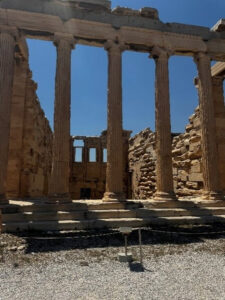
Greece offers one of the clearest illustrations anywhere in the world that adaptive reuse is not a recent sustainability concept but an ancient and continuing practice with profound modern relevance. Across Athens, Crete, and the broader Mediterranean, buildings have been altered, repaired, repurposed, and reoccupied for centuries, and that long inheritance is becoming more instructive than ever as architects, developers, preservationists, and sustainability professionals reconsider whether the best building is often the one that already exists.
In Athens, adaptive reuse is closely bound to cultural memory, with former industrial buildings, neoclassical structures, and historic urban sites being thoughtfully reimagined as cultural, residential, and commercial spaces. The former FIX brewery, which now houses the National Museum of Contemporary Art, and the old public tobacco factory, which now serves as a cultural and parliamentary space, together demonstrate how buildings once considered obsolete can become civic assets rather than demolition debris, preserving architectural character while relieving the pressure for new construction and the urban sprawl that so often accompanies it.
Crete provides a smaller-scale but equally compelling example, where the careful renovation of historic stone houses, including projects such as the Blue Daisy House, reflects a more intimate form of reuse. Rather than replacing older vernacular structures outright, these projects retain original stone walls, traditional building forms, and locally sourced materials while adapting the interiors for contemporary living, and the result is not merely preservation for the sake of nostalgia but a practical model for low-impact development rooted in place, craft, and material continuity.
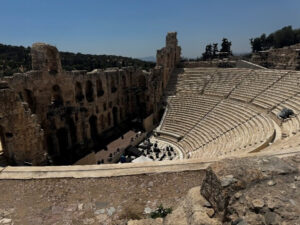
Greece also shows that adaptive reuse and sustainable construction extend well beyond historic preservation, as large-scale projects such as The Ellinikon in Athens reveal the country’s growing investment in low-carbon materials, circular construction, green infrastructure, and large-scale urban regeneration. New construction will always have its place in development, yet Greece’s most compelling sustainability story may lie in the deliberate combination of old and new, preserving heritage wherever it is feasible, using lower-carbon materials where new building is genuinely necessary, and designing cities that respect both collective memory and the limits of available resources.
The United States, by comparison, has built a more formalized deconstruction and building-material reuse sector, yet it also confronts a far larger waste problem. According to the U.S. Environmental Protection Agency, the country generated roughly 600 million tons of construction and demolition debris in 2018, more than twice the volume of municipal solid waste produced that year, and demolition alone accounted for more than ninety percent of that total. Figures of this magnitude make deconstruction, salvage, and adaptive reuse essential tools for reducing landfill disposal, conserving embodied carbon, and extending the useful life of materials that still hold real and recoverable value.
Compared with Greece, the American market tends to treat deconstruction as a technical, regulatory, or tax-driven process, with reuse frequently tied to IRS charitable donation appraisals, landfill diversion requirements, LEED credits, municipal ordinances, and the resale value of architectural salvage. Greece, by contrast, more often approaches reuse through the lenses of cultural continuity, tourism, heritage preservation, and vernacular architecture, and both orientations carry genuine value, since the United States offers scalable infrastructure and data-driven waste reduction while Greece offers a deeply embedded understanding that buildings are meant to evolve across generations rather than be discarded at the end of a single use.
The strongest lesson Greece has to offer is that reuse should never be regarded as a secondary option, because it can serve instead as a primary design strategy. Historic masonry, stone, tile, timber, doors, windows, fixtures, and architectural ornament are not simply remnants of the past; they are stored environmental value, and when they are preserved in place or carefully salvaged for reuse, they reduce the demand for the new extraction, manufacturing, transportation, and disposal that fresh construction would otherwise require.
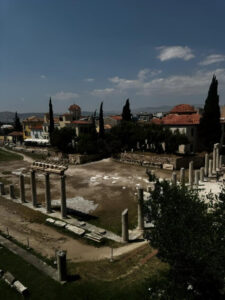
For the United States, Greece offers a reminder that deconstruction is about far more than waste management, encompassing identity, craftsmanship, and continuity, while for Greece, the United States offers concrete examples of how reuse can be reinforced through formal policy, professional valuation, tax incentives, organized salvage networks, and measurable diversion goals.
Both countries are moving steadily toward the same conclusion, namely that demolition should no longer be the default. Whether the project is a neoclassical building in Athens, a stone house in Crete, a commercial building in New York, or a mid-century structure in the Midwest, the inquiry should begin with the same question, which is what can be retained, repaired, reused, or responsibly deconstructed before anything is sent to a landfill.
Adaptive reuse is therefore not merely a passing design trend; it is one of the most practical sustainability strategies available to the built environment today. Greece shows that buildings can carry memory forward across centuries, the United States shows that reuse can be systematized and brought to scale, and together they point toward a more circular future, one in which buildings are valued not only for what they can become but for everything they already are.
Sources
- Astydama, “Preserving Cultural Heritage in Athens Through Adaptive Reuse.” https://astydama.com/our-blog/preserving-cultural-heritage-in-athens-through-adaptive-reuse/
- designboom, “Old Stone Blue Daisy House Renovation, Crete, Greece.” https://www.designboom.com/architecture/old-stone-blue-daisy-house-renovation-crete-greece-01-27-2023/
- Sunset Green Home, “Adaptive Reuse and Deconstruction, Roman Style: Lessons from the Ancients.” https://www.sunsetgreenhome.com/blog/2014/6/23/adaptive-reuse-and-deconstruction-roman-style-lessons-from-the-ancients
- IOP Conference Series: Earth and Environmental Science, vol. 1558, article 012020. https://iopscience.iop.org/article/10.1088/1755-1315/1558/1/012020
- Holcim, “Building Icons: Sustainable Construction at Athens’ Ellinikon.” https://www.holcim.com/building-icons-sustainable-construction-athensellinikon
