
A Four-Part Briefing for Donors, CPAs, and Tax Attorneys
By Jessica I. Marschall, CPA, ISA AM | The Green Mission Inc. | June 2026
Non-cash charitable donations of deconstructed building materials offer one of the few places in the Internal Revenue Code where sound environmental practice and tax policy align directly. That alignment only holds when the supporting appraisal can withstand examination. Under DEFRA, a donor gets one opportunity to secure an IRS qualified appraisal from an IRS qualified appraiser, to confirm the donee’s contemporaneous written acknowledgment, and to complete Form 8283 correctly. This series explains, in four parts, where deconstruction appraisals fail, what the federal courts have already rejected, why the Sales Comparison Approach remains the IRS standard, and how a donor and the donor’s advisors can confirm that the report in hand will hold.
Inside the Series

PART I
Anatomy of a Flawed Deconstruction Appraisal
What Donors and Their Advisors Should Look For in IRS Qualified Reports
Identifies the five recurring patterns that expose donors, CPAs, and tax attorneys to disallowance and to penalties under Sections 6662 and 6695A: the Cost Approach used as a default, arbitrary depreciation applied to new construction costs, the assertion that no secondary market exists, misapplication of cost segregation methodology, and the aggregation of components that were never actually donated. It then sets out what a properly produced IRS qualified appraisal looks like instead.
KEY TAKEAWAY A defensible appraisal begins with an itemized list of what the donee actually receives, each line researched against settled secondary market sales.

PART II
Mann and Loube
What the Courts Actually Rejected in Deconstruction Appraisals
Examines the two clearest federal precedents on deconstruction appraisals: Mann v. United States, decided in the District of Maryland and affirmed by the Fourth Circuit in 2021, and Loube v. Commissioner, T.C. Memo 2020-3. Both relied on Cost Approach methodology produced through construction estimating software, both aggregated components without verifying actual donation, and both ended with the taxpayer losing the entire deduction. Mann disallowed a stated value of $313,353; Loube turned on a Form 8283 defect.
KEY TAKEAWAY The district court in Mann described the proper method directly: a Sales Comparison Approach applied to the property the donee actually removed.

PART III
The Secondary Market Exists
Why Sales Comparison Remains the IRS Standard for Deconstruction Appraisals
Rebuts the linchpin of the rejected methodology, the claim that no settled, arm’s length secondary market exists for used building materials. The studies cited in support of that claim, including those from the EPA, the Army Corps of Engineers, and the Delta Institute, describe a developing and regionally uneven market, not an absent one. Treasury Regulations require valuation in the market where property is most commonly sold to the public, which for salvaged materials is the architectural salvage retail and auction market.
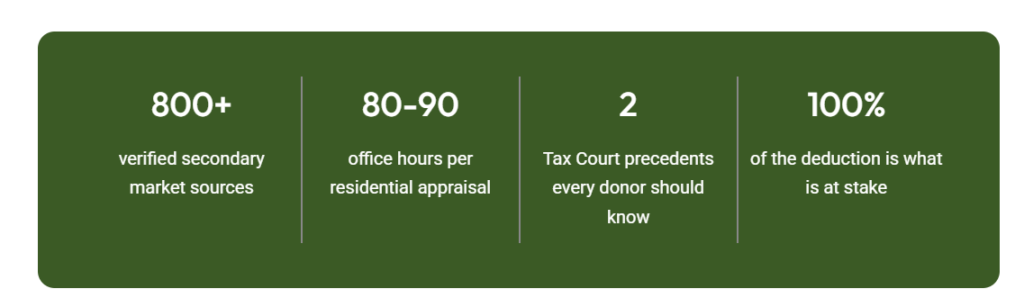
KEY TAKEAWAY The firm maintains a proprietary database of more than 800 verified secondary market sources, and most donated categories map to documented settled sales.

PART IV
Protecting Your Deduction
A Donor’s Checklist for Vetting a Deconstruction Appraisal
Provides a concrete checklist for donors and their advisors to apply before engagement, during the inspection, on receipt of the draft appraisal, and when confirming Form 8283 compliance. It catalogs the red flags that should halt an engagement, including reliance on construction estimating software such as R.S. Means or Marshall and Swift, flat depreciation factors applied across all property, and aggregation of components by square footage.
KEY TAKEAWAY The cost of one to two hours of CPA review against the checklist is small relative to the losses the courts have already memorialized.
Read the full series
About The Green Mission Inc.
The Green Mission Inc. produces IRS qualified, USPAP compliant personal property donation appraisals for deconstruction and reuse projects. The firm applies the Sales Comparison Approach as its primary methodology, supported by a proprietary database of more than 800 verified secondary market sources and hundreds of thousands of data points spanning architectural salvage retailers, auction houses, reclaimed lumber dealers, and online marketplaces. Each appraisal is built from an itemized list of the property the donee actually receives, with documented comparable sales reconciled into a defensible opinion of value. The firm’s work is grounded in the methodology the federal courts have endorsed and the Internal Revenue Service has asked for, with the goal of protecting the donor’s deduction at the moment it is examined.
